Day 3 (March 14, 2026): Tour of Santiago Island
For our first full day in Cabo Verde, we arranged a group tour. For those who know us well, you’re likely gasping at that, as David and Pam do not do group tours. Truth be told, we have, on occasion, done them when the situation necessitates it. Given the amount of territory to cover on Santiago island and, still licking our wounds from a brutal around-the-island self-drive in Grenada last November, we felt this would be the best way to go today.
We ended up thoroughly enjoying it. There were 12 of us on the tour, plus a guide and a driver. Besides us, four were from France, two were from Portugal, two were from Germany, and two were from England. The chemistry was great and the guide was excellent - both these things can make or break a tour experience. We saw a lot and learned a great deal.
Once we returned from the tour, we were zonked. We took a nap, ate a light dinner int he hotel’s restaurant, and called it a day.

This morning, the waiter at the hotel restaurant brought us cappuccinos with a great message to start the day: “Bom dia” means ‘good day’ in Portuguese.

Goats for sale at the main Praia market in the city centre.

Drivers in Cabo Verde like to drive clean vehicles. Hand car washes are a-plenty, like this one in the city centre, which we passed at the start of our tour.

Also on our way out of the city, we saw this ad for a right-wing populist politician spray-painted on a wall. Korpu Rixu is the would-be next president of Cabo Verde.
 It doesn’t matter where you go, roadworks crews always seem bloated, compared to the task at hand and the amount of work being done!
 Mountains of Santiago

Not far from Praia, we began to see evidence of the spectacular mountains that characterize the country.

Mountainous terrain and jagged peaks in the centre of Santiago Island.


Assomada
Assomada is the second largest city on Santiago Island and has been the seat of government for the Municipality of Santa Catarina. We spent time wandering the streets and visiting the market there.

One section of the city contains numerous murals, depicting the culture of Cabo Verde. Above and left, for example, you see a woman making cachupa, the country’s most famous and popular dish. (It’s a rich stew made with hominy, beans, vegetables and seasoned meat.) To the right, a woman performs the famous batuku dance, with a circle of women keeping rthyym on tchabeta - percussion pads made of compressed cloth.


The main pedestrian avenue in Assomada.

The ‘town hall’ of the Municipality of Santa Catarina.

A woman sells used clothes near Assomada’s market.

Vegetable sellers at Assomada’s market. For an arrid island, we were blown away by the amount of fresh vegetables!
The fresh fish section of the market was amazing. The women cut the fish and sell it.


Fresh tuna.

 Creole sausages.
75% f the country is Catholic, but there are also some Protestant denominations with a presence, including the Church of the Nazarene.


Malagueta Reserve, in the north/central portion of the island features a man-made lake - a rarity on this arrid island.
Transporting Goods… On One’s Head!
We were simply flabbergasted by all the people who carry their goods on their heads here! Here is a small collection of those we saw.


Just outside Tarrafal in the northwest is Chao Bom Concentratioin Camp. From 1936-1954, while Cabo Verde was under Portuguese rule, the camp was used to intern fascists from Portugal. It was revived again in 1961 until the fall of the Portuguese dictator in 1974, to intern activists, intellectuals and freedom fighters from Angola, Guinea-Bissau and Cabo Verde. The worst punishment was to be thrown in the ‘frying pan’, an exposed solitary confinement cell in the blazing sun, which usually led to a slow death. Official records say 36 people died at the camp in its years of operation, but the general consensus is that the actual number of deaths was much higher.

Tarrafal
Tarrafal is a stunning beachside fishing community in the island’s northwest. We had lunch here and spent an hour on the beach.

Santo Amaro Church

Tarrafal Beach is home to a large fleet of small fishing boats.


Tarrafal Beach

Tarrafal port

Fruit sellers on Tarrafal Beach

Tarrafal Rock

Men playing ouril on Tarrafal Beach.


A barbecue vendor selling chicken, bababs, sausages and octopus near Tarrafal Beach.
Down the East Coast of Santiago Island

The road down the east side of the island is made of cobblestone. It’s a narrow highway that is rough, rough, rough — especially when you’re riding in the back seat of a minivan and feel every bump.
 |
| Vista of the rugged east coast |

Ribiera da Lagoa on the east coast.
Calheta de Sao Miguel
Our tour group stopped at this small seaside town, just to experience such a place. Sensing the group’s energy to be waning, our gregarious and incredibly energetic tour guide, Bravo, got us all into a circle to play a game of “Boom!” We had a blast! Pam won.


Papaya tree

The town has the strangest home: a caste of sorts, complete with turrets. Rumour has it the owner is from Paris.

We’ve seen many people today carrying sacks on their heads. Turns out, they are filled with yellow seed pods.

Another stop to energize the gang, and Bravo taught everyone (who was brave enough) to dance the batuku.

My favourite photo of the day.

Local transportation in Cabo Verde is by minivan, for those who can afford 150 Escudos ($2.25 CAD) for a ride along.a set route. For those with less coin to spare, pick-up trucks like this one also ply many routes. The trucks have two benches lining the sides of the box.
Plantation Visit
In the southeast corner of the island, we visited a plantation, where bananas were the main crop, but coconuts and papaya were also grown.

You likely know that bananas grow upward, and not downward, as many think they do.

Also, in order for the bananas to develop, the male flower has to be cut off.
 Papaya
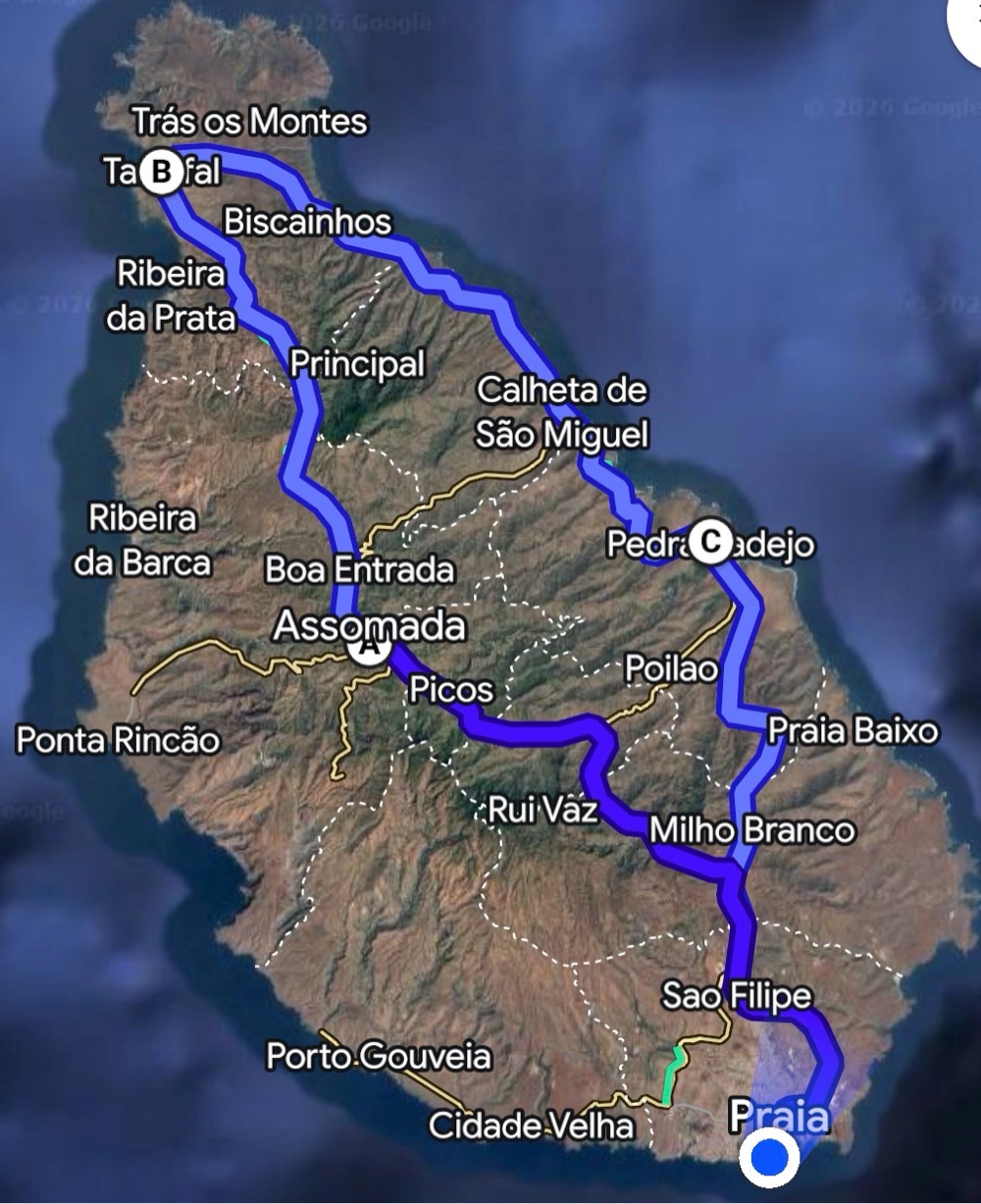 |
| All in all, we covered exactly 150km on our tour of the island, leaving the hotel at 9:15AM and arriving back there nine ours later, at 6:15PM. We normally do island tours like this on our own, in a rental car. But we really did enjoy today’s group experience. Bravo to Bravo, from Kapverden Tours for his enthusiasm and knowledge - we learned so much about Santiago Island! |

Comments
Post a Comment